Brief History of IDEAL Group and its Subsidiary Companies
In September, 1991, NCR Corporation was acquired by AT&T. NCR was renamed "AT&T Global Information Solutions." In December, 1993, a team of AT&T employees formed a New Jersey-based not-for-profit corporation called IDEAL at AT&T. IDEAL was an acronym that stood for Individuals with Disabilities Enabling Advocacy Link. The goal of IDEAL at AT&T was to work with AT&T management to make the right choices when implementing AT&T’s business principles based on corporate values known as "Our Common Bond." AT&T's Our Common Bond business principles were (are):
Respect for all individual and cultural differences in our diverse society.
Dedication to serving our customers optimally, and to building long-term relationships with our partners in the community.
Devotion to the highest standards of integrity and to open communication that reports the objectives and results of our work.
Commitment to innovation in meeting the needs of communities and applying the resources of AT&T.
Support for teamwork between AT&T people and their community partners.
Steve Jacobs, who
previously served as NCR Corporation's Accessibility Manager, became
an active member of IDEAL at
AT&T.
In that same year, Steve
assumed Chairmanship of AT&T
Bell Labs "Project
Freedom." Project Freedom's mission was to develop new and advanced
Assistive Technology (AT) in support of individuals with
disabilities. With the support of: 1) AT&T Electrical Engineers;
and, members of
AT&T's
Consumer Advisory Panel on Disability Issues (CAPDI), Project Freedom pioneered the use of
interactive video technology for sign-language communications over
distances using dual ISDN networks. This was the first time
advanced video technology was used to
facilitate two-way
"voice telephone" ASL conversations!
Project Freedom's work was commemorated
in a 1994
video. The
ASL conversation took place
between students and teachers from the Horace Mann Montessori School in
Dayton, Ohio. The
video also showcased historical footage of
Alexander Graham Bell. Although a
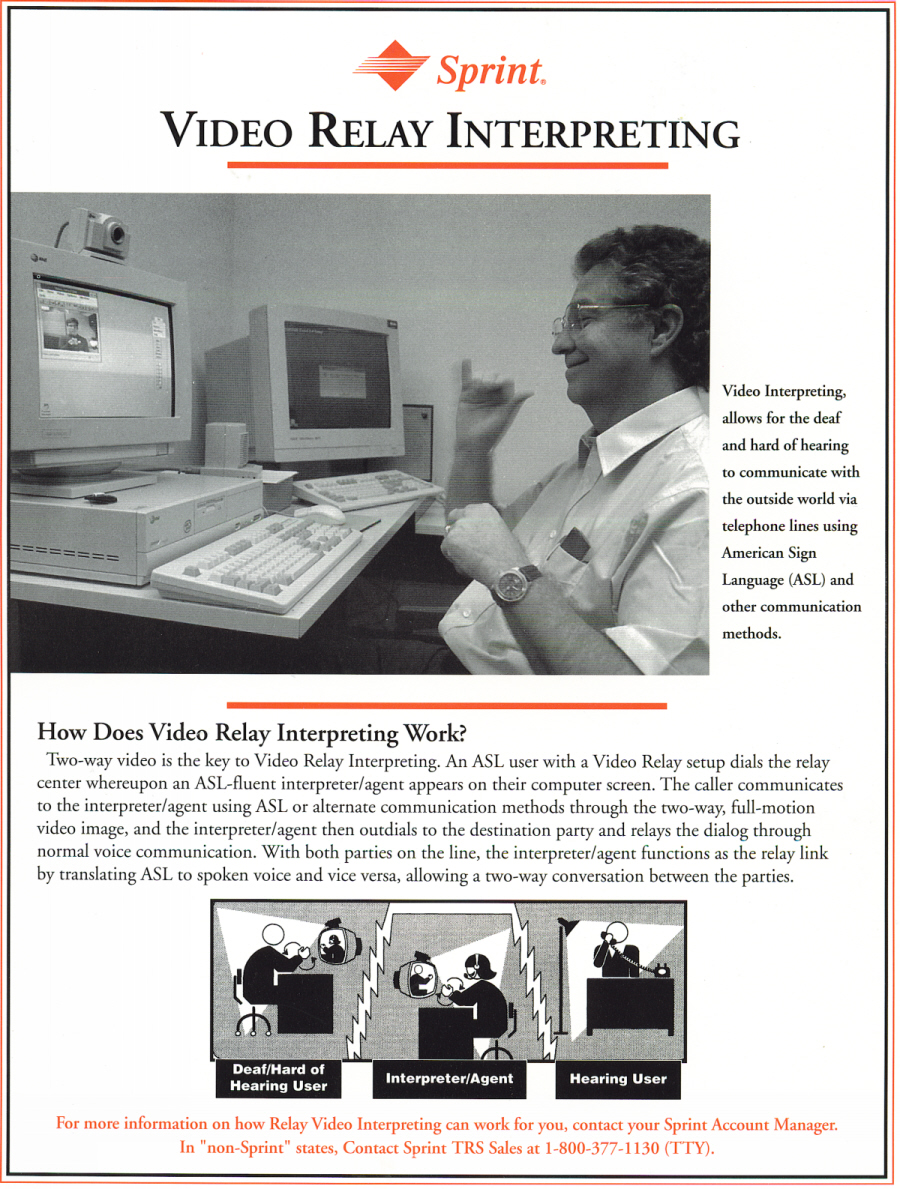
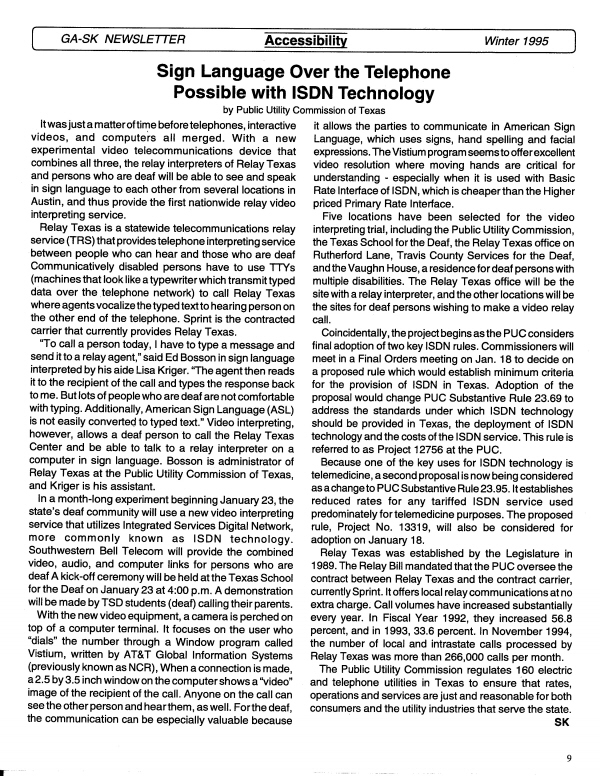
competitor, Sprint used
AT&T Project Freedom's Vistium Video System hardware
and infrastructure to conduct the
world's first Video
Relay Services (VRS) pilot test in Texas in 1995.
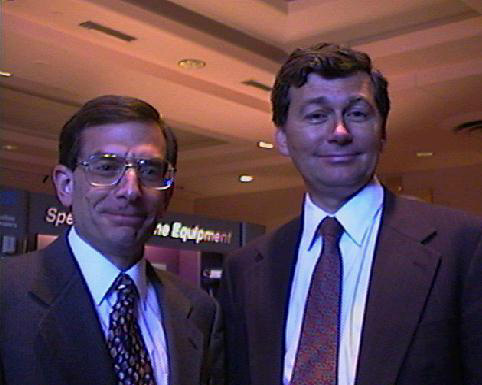
Here's a 1994 photo of
Reed Hundt, FCC Chairman (November
29, 1993 to November 3, 1997) and Steve Jacobs,
AT&T Project Freedom Chairman,
demonstrating VRS to FCC Commissioners.
In 1996, a restructuring of AT&T took place, leading to the re-establishment of NCR Corporation as a separate company. From January, 1997 through July, 1999, Jacobs carried on IDEAL at AT&T's, and AT&T Project Freedom's work, as president, under the name "IDEAL at NCR Corporation." At that time, IDEAL at NCR operated under IDEAL at AT&T's charter. On August 10, 1999 Steve incorporated IDEAL as an NCR not-for-profit corporation under the name "IDEAL at NCR." From 1999 -2002, IDEAL supported NCR's work to design, develop, and release financial/retail products and services that were as accessible as reasonably possible.
IDEAL at NCR's technical accomplishments were many. Here are a few examples of IDEAL at NCR's high-level projects:
Bush 54th Inauguration
Technology Project:
Integrated technology into George W. Bush's inauguration program
and guidebook. The project repurposed technology being used by the
Israeli military to come up with a method that enables a person
who is blind to scan 77 pages of text... with only one pass of a
scanner, with 100% accuracy.
54th Program Book (See Page
32):
http://www.ideal-group.org/initiatives/inauguralprogram.pdf
54th Guide Book (See Page
77)
http://www.ideal-group.org/initiatives/inauguralguidebook.pdf
Edgar Online: Bush
Presidential Inauguration Publications Use High-Tech Code:
http://sec.edgar-online.com/2001/01/17/13/0001093197-01-500011/Section6.asp
IDEAL at NCR and Intacta
Technologies, Inc. Demonstrate New Accessibility Technology
http://www.ventegis-capital.de/beteiligungsnews/news2000/26-9-2000.htm
Fifty-Fourth eNaugural.com Ball Webcast:
Hosted fully-accessible 54th
eNaugural.com Ball Webcast:
http://www.ideal-group.org/initiatives/eNaugural_Ball_Broadcast.htm
Smithsonian Institution:
Designed, developed, and implemented
accessible prototype kiosks for the Smithsonian Institution's American
History Museum.
President Clinton's Digital Divide Tour:
Photo:
http://www.ideal-group.org/initiatives/clinton_photo.htm
Technology Demonstrations:
http://clinton4.nara.gov/WH/new/html/Tue_Oct_3_133607_2000.html
Vice President Gore's Digital
Talking Book:
Published a Digital Talking Book in support of
a reception held at the residence of Vice President Gore.
Business Week Article:
http://www.businessweek.com/bwdaily/dnflash/aug2000/nf20000830_822.htm
Photo:
http://www.ideal-group.org/initiatives/photo_gore.htm
Internet Resource Center for the 53rd Presidential Inauguration
President Clinton's 53rd
Presidential Inauguration:
Integrated technology into the 53rd
Presidential inaugural program book.
Inauguration Program Book:
http://ideal-group.org/initiatives/53.htm
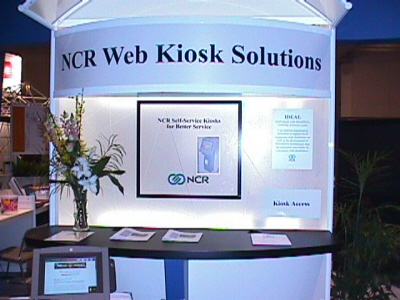
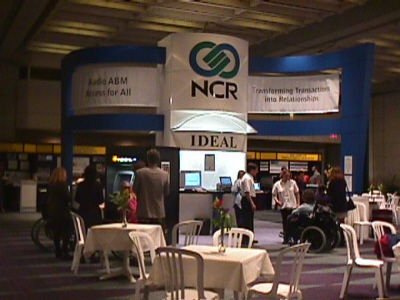
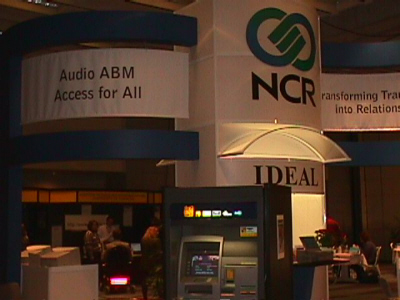
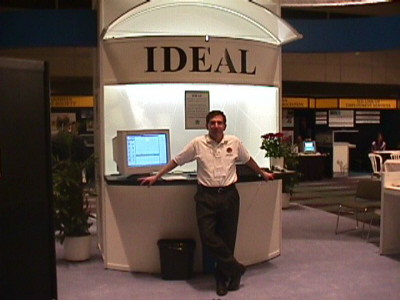
Here are a few IDEAL at NCR trade show photos:
At the end of December, 2002, Jacobs retired from NCR Corporation and was granted permission to spin-off IDEAL at NCR into IDEAL Group, Inc. On June 4, 2003, IDEAL Group, Inc. was incorporated as a privately held, Ohio-Based, Social Entrepreneurship corporation. Since that time IDEAL Group has successfully managed and completed 140 development projects and established three subsidiary companies, all focused on accommodating the access needs of individuals with disabilities through the use of advanced technology.
IDEAL Group's subsidiary companies are as follows:
InftyReader Group, Inc.
Established in March, 2007, InftyReader
Group offers a sophisticated optical character recognition
application that is used by thousands of universities around the world
to recognize, convert, and enable the editing of Science, Technology,
Engineering, and Math (STEM) educational content (both print and
digital) into accessible formats in support of students with print
disabilities. Converted formats include LaTeX, MathML, Human Readable
TeX, and Word XML. In 2012, IDEAL Group received a White House Champions
of Change Award for enhancing the accessibility of STEM curriculum for
students with disabilities.
Apps4Android, Inc.
Established in January, 2009, Apps4Android is
a social entrepreneurship company. Apps4Android’s primary objective is
to facilitate widespread technological changes that enhance the
independence, quality of life, and employability of individuals with
disabilities. Apps4Android is now the world’s largest developer of
Android applications designed in support of individuals with
disabilities, with 25+
million installations. Apps4Android apps are installed on the devices
of 82
wireless manufacturers and distributed by 568
wireless service providers in 143
countries.
Knowledge Discovery Solutions, Inc.
Established in 2014, Knowledge Discovery Solutions http://kds.global, a
joint venture company of IDEAL Group, Inc. and Shaping Tomorrow from the
United Kingdom. KDS
provides knowledge-mining resources
and solutions in support of gathering “anticipatory intelligence” to
help schools, colleges, universities, and government agencies:
Identify and act upon emerging opportunities; and,
Identify the risks associated with those opportunities...
...in the areas of:
Educating students with disabilities K-20;
Disability policy;
Assistive Technology; and,
Advanced accommodation strategies.
Today, IDEAL Group, along with its subsidiary companies, continue to enhance the independence, quality-of-life, employability, and quality-of-education of tens-of-millions of individuals with disabilities around the world.
For more information about IDEAL Group, or any of its subsidiaries, please contact:
Steve Jacobs
President and CEO
IDEAL Group, Inc.
10080 Gerich Lilly Rd.
West Jefferson, OH 43162
Cell: (614) 777-0660
Fax: (614) 522-1031
TTY: (800) 750-0750
Skype: stevenijacobs